(Beaver Dam) Elected officials in Beaver Dam Monday night heard a presentation on the different types of debt cap policies used by municipalities. Beaver Dam has been operating under a self-imposed debt cap since 2010 that sets yearly borrowing for streets, buildings and equipment at $1.7-million dollars, which can only be exceeded with three-fourths vote of the council.
Finance Director Jeff Wiswell noted the city’s annual credit analysis from Moody’s Investment Service in saying that the policy is out-of-date, based on decade-old debt, revenue and expenditures numbers.
Some communities base a cap – if they have one – on debt versus total equalized property values while others base the cap on debt as a percentage of revenues, debt per levy dollar or debt per capita.
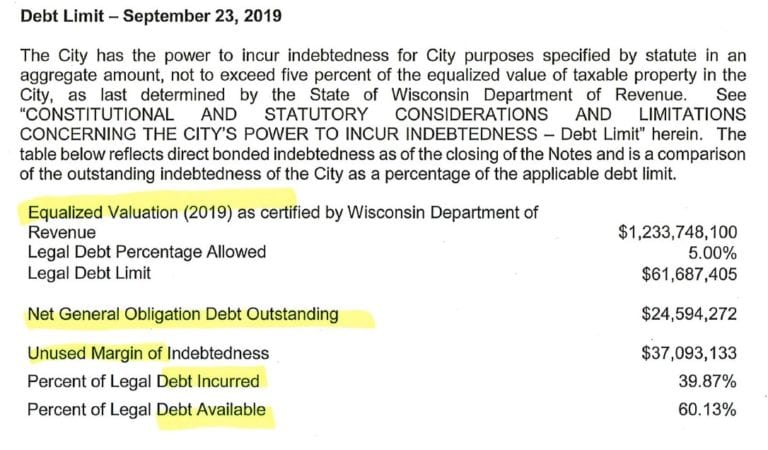
Using a policy based on total equalized property value as an example, Wiswell explained that Beaver Dam has a total value of $1.23-billion dollars. The state says debt can comprise no more than five-percent of that total value, which for Beaver Dam is around $61.7-million dollars. Beaver Dam currently has less than $25-million dollars in outstanding debt putting the city’s total debt capacity at just under 40-percent, or another $37-million dollars.
Some communities like Ashwaubenon, home of the Packers, use 100-percent of their debt capacity. Wiswell says his research has shown that many communities in the state similar to Beaver Dam – that have a cap in place – have a debt capacity between 50-percent and 65-percent. Wiswell suggests that the needs of the city be more closely aligned to debt capacity.
It would be up to city officials to decide where to draw the line, and some had a different take on the report. Alderman Jack Yuds says being at 39-percent of the city’s debt capacity is too high to pass along to the next generation while Alderwoman Jane Loizzo says the city is in a good position to borrow to address needs now.
Any changes to the debt policy are expected to be discussed after the 2020 budget is adopted. Before that, city officials will be deciding this month if they’ll exceed their current $1.7-million-dollar borrowing cap. Among the projects recommended for next year is the $3-million-dollar reconstruction of South Spring Street.
Read details of the Debt Cap presentation here:
Agenda Packet 9.30.2019 20190927131139736 1.0919
Listen to Jeff Wiswell’s presentation here: